
There’s a kind of tiredness that has nothing to do with sleep. You wake up with it already installed. It feels less like exhaustion and more like static. Too many tabs open in the mind. Too many unfinished gestures. Too many tiny negotiations with the day before it has even started. For a while I thought this was just adulthood. Or work. Or the news cycle. Pick your villain.
Then, a few weeks ago, I read Oliver Burkeman’s book Four Thousand Weeks. In one chapter, his basic claim is disarmingly simple: modern people don’t merely live in time, we treat time as something like a budget or a storage unit — something to fill efficiently, optimize, defend from waste. Hours become containers. Empty ones feel like failure. Overfull ones feel like guilt. Either way, we’re measuring constantly. Reading it, something clicked. Not because it was revolutionary, but because it named a background hum I’d stopped noticing.
A few days later I stumbled across a long piece in Die ZEIT about people who had spent time in monasteries. Writers, theologians, monks. The article describes the daily rhythm shaped by the Rule of St. Benedict: fixed hours for prayer, work, meals, sleep. Bells. Repetition. The same sequence, every day. And again and again, the people interviewed say some version of the same thing: the structure doesn’t feel constricting. It feels relieving. Decisions disappear. Energy returns. One former monk puts it bluntly — the order of time »girds the mind.«
Two very different sources. A productivity-skeptical journalist and a story about cloisters. Yet they seemed to circle the same intuition from opposite sides. It made me wonder if the problem isn’t simply that we have too much to do. Maybe it’s that too many things now happen at once.
Less Choice Can Mean Less Friction
For most of human history, daily life was organized less by clocks and more by sequences. Historians sometimes call this »task-orientation«: you do something because the situation calls for it. The cow needs milking, so you milk her. The field is ready, so you harvest. The sun sets, so you stop. Not because it’s 18:03, but because the world itself provides the cue. One thing follows another. Even after clocks took over, we still had rhythms. The train arrives, you board. It’s lunch time, you eat. Shops close, the day ends. The structure wasn’t romantic, but it was reliable. Time came in blocks. You were either here or there.
Now a lot of things overlap. Work bleeds into evenings. Messages arrive mid-conversation. Laundry runs between meetings. Plans are tentative because anyone can cancel at any moment. Your phone turns every idle second into potential input. Even the systems that used to anchor the day — trains, timetables, simple reliability — feel less dependable now, so planning becomes a gamble. Nothing quite starts; nothing quite finishes. Life becomes a stack of half-open tabs. We call this flexibility. But flexibility without form feels less like freedom and more like low-grade vigilance.
Every time there’s no clear next step, you have to invent one. Decide. Reprioritize. Check again. It’s not dramatic stress, just a constant trickle of micro-choices. When do I answer this? Should I go now or later? Can I squeeze that in? It’s cognitive overhead. The kind you don’t notice until you’re tired for no obvious reason.
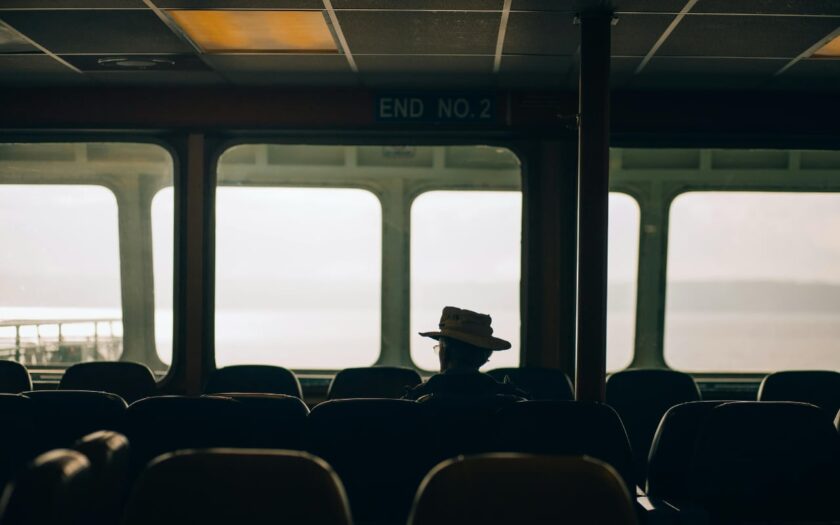
I can’t prove that this is what makes us anxious. Yes, research does link multitasking and frequent interruptions to higher stress — sometimes even in physiological measures — but it’s not a single clean cause-and-effect story. But subjectively — and anecdotally — it fits. The days when everything overlaps feel jagged. The days with a simple sequence feel strangely calm, even when they’re busy.
Which is where that monastic rhythm becomes interesting, not as a lifestyle fantasy, but as a psychological clue. The point of the bell isn’t obedience for its own sake. It’s that you don’t have to negotiate with yourself all day. The structure carries you. The question »What should I be doing right now?« simply doesn’t arise. Less choice, paradoxically, can mean less friction.
Borrowing Richard Rohr’s phrase, Burkeman calls the alternative »deep time«: moments when you stop treating time as something to manage and start simply inhabiting what you’re doing. Cooking feels like cooking. Walking feels like walking. A conversation isn’t competing with three parallel threads on a screen. The clock keeps moving, but it stops dictating your worth.
Instead of Being Ruled by the Clock, We’re Ruled by Constant Choice
What strikes me is that deep time doesn’t require slowness. Monks aren’t lazy. Farmers weren’t lounging around. You can work hard and still feel unhurried — if things happen one after another instead of all at once. Maybe the real enemy isn’t speed. Maybe it’s concurrency.
Of course, it would be naïve to romanticize the past. Medieval life wasn’t serene. Monastic rules can become cages. A few people in the ZEIT article even left when the structures began to feel restrictive, when they stopped helping and started holding them back. Today, freedom matters. Flexibility matters. No one wants factory whistles back. But we might have swung too far the other way. We escaped rigid schedules only to land in permanent improvisation. Instead of being ruled by the clock, we’re ruled by constant choice. And constant choice is its own kind of burden.
So I’m less interested these days in »time management« than in rhythm. Not optimization, not squeezing more in, just a few parts of the day that simply happen. A walk that doesn’t move. Dinner that doesn’t multitask. Something that begins and ends without negotiation. Little stretches where nothing overlaps. Not because it’s efficient. Just because it lets you arrive.
Maybe that’s all »deep time« really is: the rare feeling of being somewhere long enough that you forget to measure it. In a culture obsessed with flexibility, that might be the quietest form of resistance left.
.