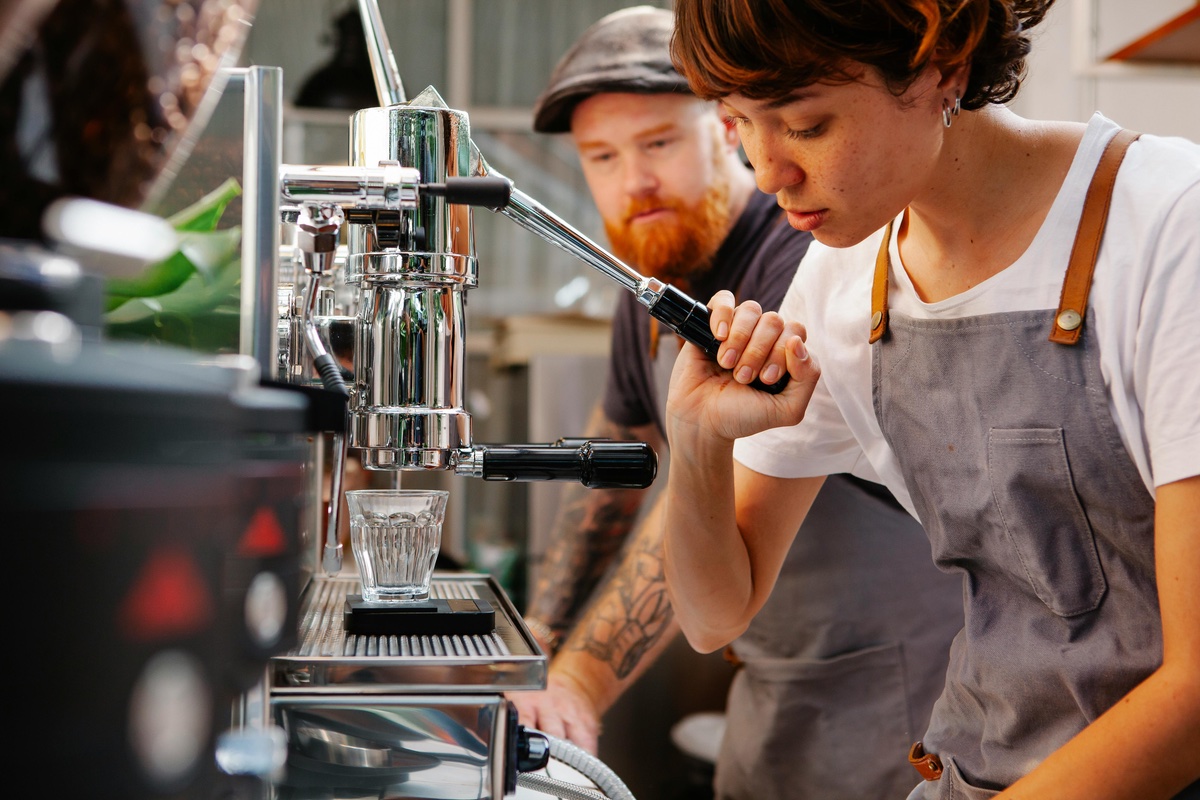
»Dump the first espresso of the day.« That was the advice, I saw in a reel the other day. A guy standing in a spotless kitchen, speaking with quiet authority. No drama, no irony. Just a clean instruction. Even if you single dose. Even if you weigh your beans to the tenth of a gram. The coffee sitting in the dead space of the grinder overnight will have oxidized. It will dull the shot. It is not worth drinking.
My first reaction was not technical curiosity. It was a quiet sense of loss. Imagine starting your morning by pouring something warm and carefully prepared straight into the sink. A small ritual of control disguised as refinement. I thought: I would not even taste it.
But maybe that is the point. Probably some people really can.
There are palates that register the faint stale edge from yesterday’s grounds. People who notice when brightness turns flat by a margin most of us glide past. The same goes for sound, for smell, for texture. Some hear the subtle hiss in a speaker that others never register. Some catch a synthetic note in a perfume long before it blooms. Their world is dense with detail.
We tend to assume that this density is pure gain. Sharpen your senses. Train your taste. Learn to distinguish. The more nuance you perceive, the richer your experience becomes. Coffee stops being just coffee. It becomes citrus, cedar, dark chocolate, ash. The city stops being noise and becomes layers. A track stops being a song and becomes frequencies, depth, space.
And yet there is another side.
Sharpening Is Not the Same as Expanding
The friend who hears everything also struggles in crowded rooms. The person who smells everything cannot ignore the faint sourness in a hallway. The trained palate that detects oxidation may also detect disappointment faster than pleasure. When your threshold for noticing drops, your threshold for irritation often drops with it.
We can train perception. That is not in doubt. Exposure and attention refine the senses. What once felt undifferentiated becomes structured and legible. The world sharpens. But sharpening is not the same as expanding.
At some point refinement can narrow experience instead of deepening it. A slightly imperfect espresso is no longer just part of the morning. It is wrong. A minor background noise is no longer ignorable. It is an intrusion. The margin for »good enough« shrinks.
At this point the issue stops being sensory. It becomes existential. We can sharpen not only our palate, but our thinking. And once thinking sharpens, it begins to separate. It distinguishes illusion from reality, comfort from truth, simplicity from contradiction. George Steiner once suggested that thought itself carries a certain sadness. Not because it is defective, but because awareness introduces distance. The more clearly we see, the less we can return to innocence.
Pairing Refinement with Range
So the real question is not whether you can taste the gram of stale coffee left in the grinder. The question is what happens to you if you can.
Does it make your world larger or more fragile? Does it add texture or reduce tolerance? Does it bring delight or constant correction? There is a version of expertise that carries ease. You taste the flaw and still enjoy the cup. You hear the distortion and still love the song. You notice the imperfection and let it pass. Sensitivity and robustness coexist. The detail enriches the whole without tyrannizing it.
And there is another version where every deviation demands adjustment. Where optimization becomes a reflex. Where the first act of the day is disposal.
I keep thinking about that first espresso. Maybe it is not perfect. Maybe someone with a finely tuned palate would wince. But it is hot. It is bitter. It marks the beginning of something. It is there.
Perhaps the art is not endless refinement of the senses, but pairing refinement with range. Train your palate if you want. Learn the notes. Dial in your grinder. Just make sure your tolerance grows alongside your precision. Otherwise you may end up with immaculate technique, exquisite perception, and an empty cup.